
They Told Us to Come Back. A Lot of Us Said No.
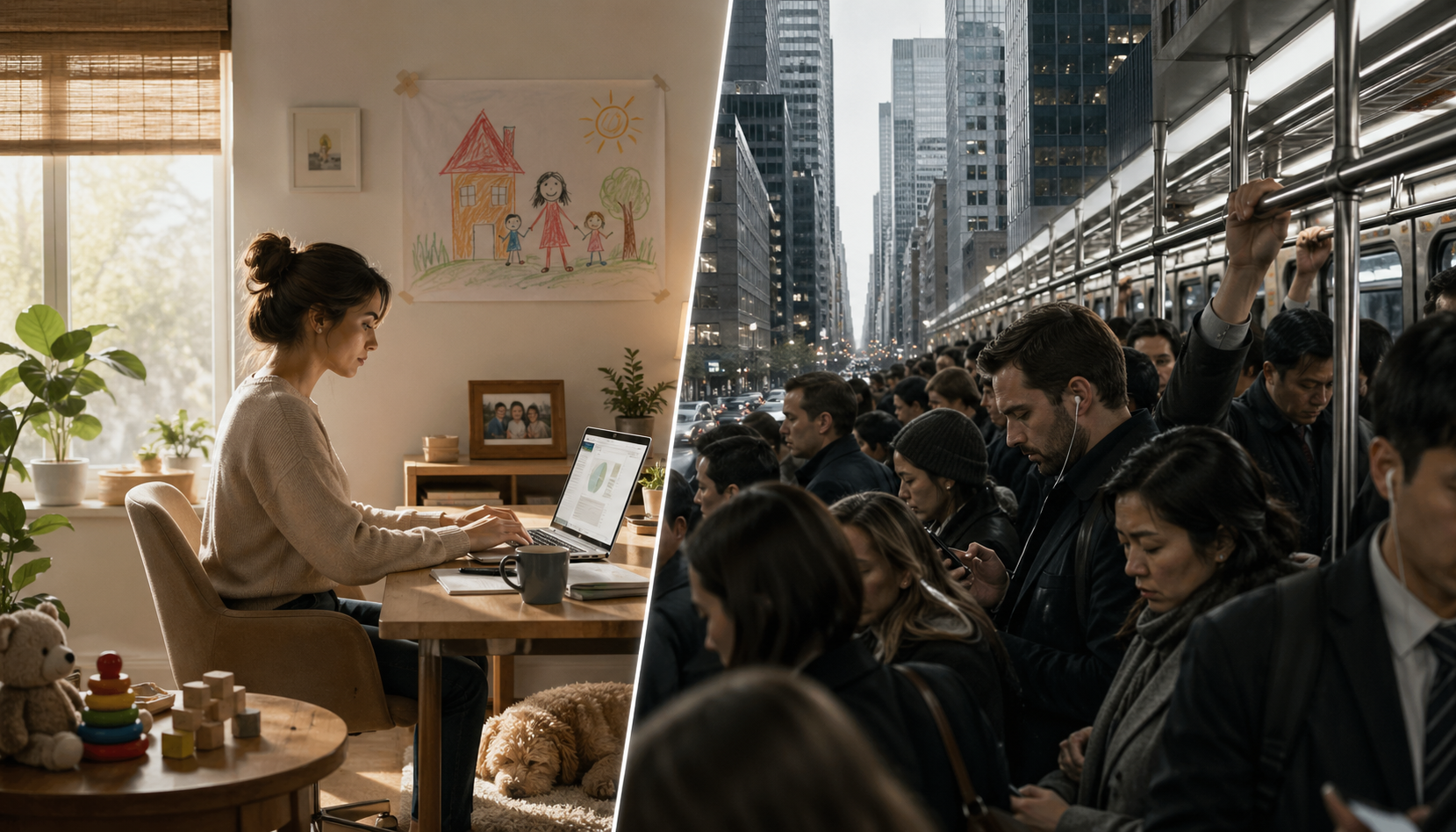
My friend Dana cried on her first day back in the office.
Not from happiness. She'd done the math that morning — 90 minutes each way, downtown Toronto, packed subway — and sat at her kitchen table for a long moment before grabbing her bag. Her daughter, three years old, had just started saying "Mama, stay." Dana had gotten used to being able to answer "okay, just upstairs" and mean it.
The mandate had come from HR in a terse Friday email. Three days a week, effective the following Monday. No exceptions except medical. No explanation beyond "in-person collaboration is core to our culture."
Dana's productivity scores had been in the top quartile of her department for two years straight. All from her spare bedroom.
She cried in the elevator. Then she composed herself, walked into a glass-walled conference room, and sat through a meeting that — everyone in the room quietly agreed — could have been an email.
Her story isn't unique. It's basically the story of the last four years of modern work, told in miniature.
The Commute Was the Villain We Didn't Know We Had
Before March 2020, most of us accepted the daily commute the way we accepted bad weather — unpleasant, inevitable, just part of life. The average North American worker spent nearly an hour a day in transit to and from work. Multiply that across a year and you're looking at around 250 hours — more than six full work weeks — sitting in traffic or pressed against strangers on a train, just to arrive somewhere you could do the same things you'd do at home on a laptop.
When the pandemic hit and commutes vanished overnight, people didn't just feel relieved. They felt robbed — retroactively. This is what I was doing every day? The hours didn't disappear; they got redistributed. Into sleep. Into family. Into exercise. Into actual work.
Productivity went up for a huge chunk of the workforce. Not because people were slacking before, but because the office, it turns out, is full of interruptions. The colleague who stops by your desk. The impromptu birthday cake in the breakroom. The open-plan noise that makes deep focus nearly impossible. At home, for better or worse, you could just... get things done.
Companies noticed. At first, most of them shrugged and said, "Well, we didn't really have a choice." But the data was hard to argue with. Knowledge workers were performing. Deals were closing. Software was shipping. And nobody had to expense the parking.
So Why the Rush to Get Everyone Back?
Here's the part nobody wants to say out loud at the all-hands meeting: commercial real estate.
Major corporations are locked into expensive, long-term office leases. A half-empty 40-story tower in downtown Manhattan or Bay Street in Toronto isn't just a sad aesthetic — it's a hemorrhaging liability. Worse, it's an embarrassing one. When a CEO explains to the board that they're paying $18 million a year for floors that sit dark three days a week, the logical question is: why?
The return-to-office mandates, in many cases, are as much about justifying sunk costs as they are about genuine operational need. Saying "innovation happens in person" sounds better than "we made a real estate bet and we need bodies in these chairs."
To be fair, some of the collaboration argument is legitimate. There's real research showing that informal hallway conversations, the accidental encounters between departments, the mentorship that happens over lunch — these things do suffer in a remote-first world. Junior employees, in particular, tend to absorb company culture and tacit knowledge faster when they're physically present. A 24-year-old starting their first job over Zoom misses things that are genuinely hard to replicate on a screen.
But "some in-person time has value" is a very different claim than "you must be in this building three days a week or face disciplinary action." One is a thoughtful operational insight. The other is a control mechanism dressed up as culture.
The Government Has a Dog in This Fight Too
This part surprises people: your mayor wants you back at your desk.
Cities are economically organized around the assumption that office workers will commute in, buy coffee, eat lunch, pop into shops, and funnel billions of dollars into downtown service economies. When that stops — even partially — it creates a kind of urban vacuum. Restaurants close. Retail thins out. Transit ridership drops, which pressures systems that were already straining under deferred maintenance and aging infrastructure.
Several major cities quietly lobbied large employers to push return-to-office plans. Not through policy, exactly, but through the kind of soft influence that happens when a city's economic development office and its largest corporate tenants are in close conversation. The message, roughly: we need foot traffic, and you're how we get it.
This creates a strange situation where the interests of individual workers — flexibility, time, sanity — are structurally opposed not just to their employers but to the tax base of the cities they live in. That's a weird coalition to be pushing back against.
Hybrid: The Compromise Nobody Is Fully Happy With
The current détente is "hybrid work" — that slippery arrangement where you're in the office some days and home on others, and everyone pretends this is a coherent policy rather than a negotiated standoff.
Hybrid has real advantages. It preserves some of the flexibility workers fought for while giving organizations the in-person time they argue they need. On paper, it sounds reasonable.
In practice, it's complicated. Which days are in-office days? If it's not coordinated, you end up with a mostly empty office on Mondays and Fridays and an overcrowded one on Wednesdays — defeating the entire purpose of "collaboration." How do you fairly evaluate someone who's remote-first against someone who's always visible to management? Proximity bias is real, and studies consistently show that remote workers get fewer promotions, even when their output is equivalent.
And then there's the texture of the workday itself. Hybrid workers often report the worst of both worlds: the interruptions of office life layered on top of the video-call exhaustion of remote life. You commute in, attend three in-person meetings, and then spend the afternoon on Zoom with colleagues who are working from home that day. You've lost the deep focus of working remotely and the spontaneous collaboration of being fully in the office.
What Workers Actually Want
Here's what the surveys, over and over, keep showing: people don't hate offices. They hate mandates. They hate being told where they have to be, on which days, regardless of what their actual work looks like on those days.
What workers want is trust. The trust that they are adults capable of deciding whether today's deep-focus coding project is best done at home, or whether this particular meeting genuinely needs a whiteboard and a room. That's it. Not unlimited remote work forever. Just the professional respect to make that call.
The pandemic didn't just change where people worked. It changed what they're willing to accept. Dana eventually left her job — found a fully remote position at a competitor, took a modest pay cut, and by her own account has never been happier. Her old company, still trying to fill the role six months later, is now advertising it as "remote-friendly."
The market has a way of teaching lessons that memos can't.
The future of work won't be one thing. It'll be loud and varied and argued about for years. But one outcome already feels settled: workers know, in a way they didn't before 2020, that the office was never the only place where good work gets done. They've lived the alternative. They've built lives around it.
And they're not going to pretend otherwise just because someone's lease is up in 2027.