
The Companies That Never Had an Office Are Watching the Return-to-Work Debate and Scratching Their Heads
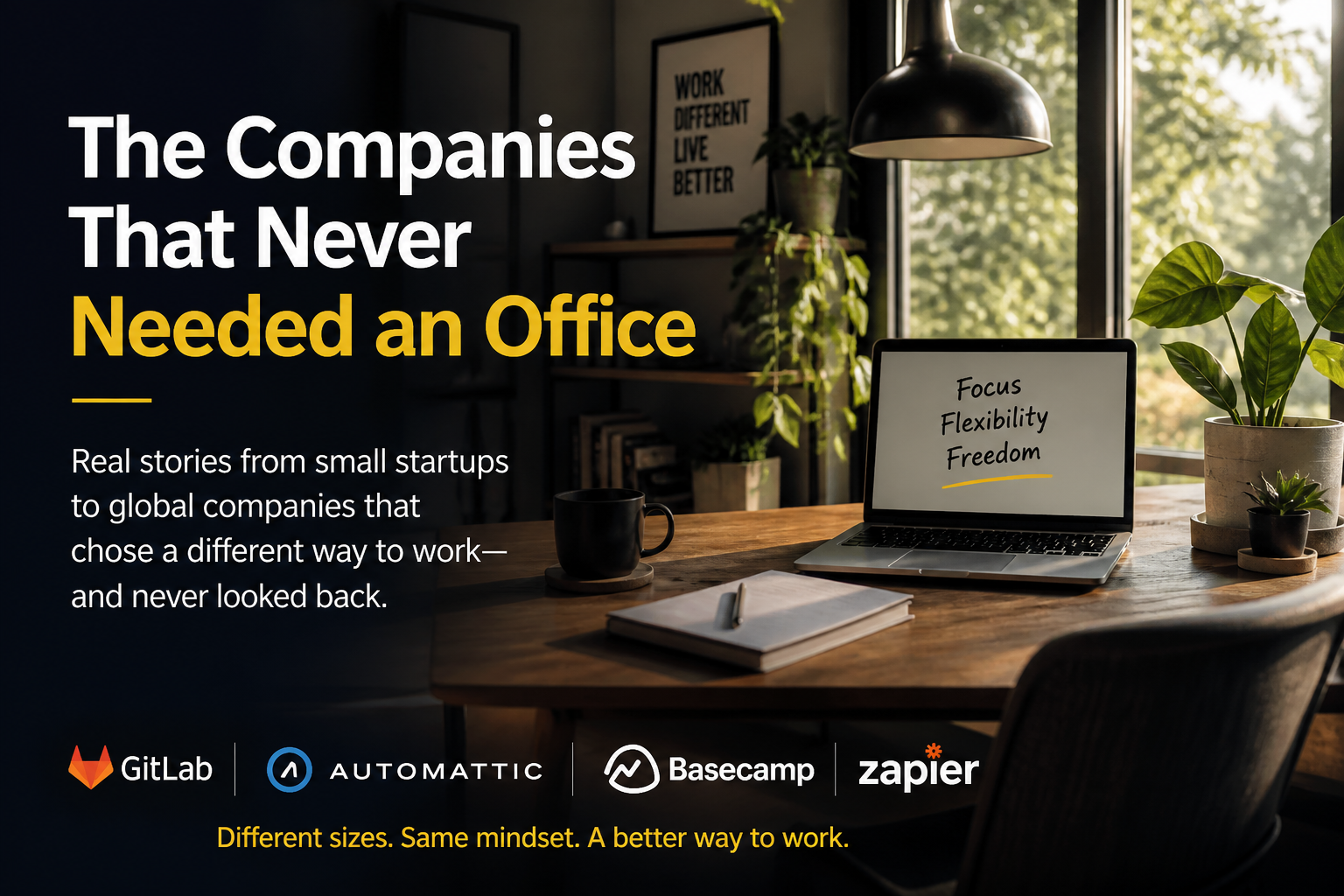
Some companies didn't return to the office after the pandemic.
They never had one.
No lease. No conference rooms. No parking validations, no breakroom passive aggression over whose yogurt is whose. Just work. And now, while the corporate world is locked in this exhausting tug-of-war about mandates and hybrid schedules and proximity bias — these businesses are watching the whole thing unfold with a kind of quiet bewilderment.
They made this decision years ago. Not as a bold strategic vision. Not because they read a think-piece about the future of work. They did it because they couldn't afford not to.
It Started With a Kitchen Table
We know a couple of small businesses — one person, maybe two — that went remote before remote was a thing anyone talked about. No big announcement, no company-wide Slack message about "embracing a new way of working." Just a laptop on the kitchen table and a spare bedroom that doubled as an office. Work happening between school pickups, in the gaps of ordinary life.
At the time, it didn't feel innovative. It felt like making do.
There was no philosophy behind it. The philosophy was: this is what we can afford, so this is what we'll do. Office space costs money. Money was tight. Problem solved.
Then 2020 hit, and suddenly every knowledge worker on the planet was doing the exact same thing — sitting in their homes, on video calls, figuring out how to get their job done without a building to go to. And for these small businesses, the weirdest thing happened. Something that had always felt like a compromise — a scrappy workaround for people who couldn't afford the real thing — was suddenly being hailed as the future.
What looked like a limitation turned out to be a six-year head start.
The Company That Quietly Gave Up Its Floor
Then there's a business we know, around 60 people, that took a different path. Before the pandemic, they had a proper office — a full floor, desks, meeting rooms, the whole setup. They went remote in March 2020 like everyone else, assuming it was temporary.
But later on, someone ran the numbers. Productivity hadn't collapsed. Deals were still closing. The work was getting done. What hadn't gone away was the lease. The utilities. The cleaning contracts. All of it still ticking over every month for a building that sat mostly empty.
So they made a decision. Quietly, without fanfare. No press release. No all-hands to announce a bold new chapter. They just let the lease expire and didn't sign a new one.
That was it. The office was gone.
It's a story that sounds almost anticlimactic in the telling, but it's actually pretty radical. Most companies in that position — with the data pointing one way and the sunk costs pointing another — choose to ignore the data. This one didn't.
The Companies That Were Born This Way
At larger scale, you start to see this pattern become a genuine operating philosophy. GitLab — a company with thousands of employees — has been fully distributed since it was founded. No headquarters. Colleagues who have worked together for years and have never been in the same room. Automattic, the company behind WordPress, operates the same way. So does Zapier. These aren't scrappy startups figuring things out as they go; they're mature businesses running complex operations across dozens of countries without a central office to anchor them.
They didn't go remote because of the pandemic. They didn't even go remote as a deliberate experiment. They just built their companies around the idea that good work doesn't require a specific building, and they optimized everything — their communication, their culture, their hiring — around that assumption. The pandemic, for them, was basically a non-event. While other companies scrambled to figure out remote collaboration tools in a panic, these businesses had already solved that problem half a decade earlier.
So Why Is Everyone So Desperate to Get Back?
Here's where the story gets uncomfortable.
If remote work works — and the evidence, at this point, is pretty hard to dismiss — why are so many large companies pushing so hard for a return? Some of the reasons are legitimate. Collaboration does happen more naturally in person. Mentorship is genuinely harder across a screen. There's something real about the random hallway conversation that turns into a product idea, or the junior employee who absorbs institutional knowledge just by being physically present around experienced colleagues.
But then there's the other reason. The one nobody leads with in the company memo.
Office leases are long. Ten, fifteen, twenty years in some cases. And right now, a lot of major corporations are sitting on enormous commitments to commercial real estate that made perfect sense in 2018 and look a lot harder to justify today. An empty floor in a downtown tower isn't just aesthetically sad — it's a financial liability that someone has to explain to the board.
Cities have skin in the game too. Downtown economies are built around the assumption of commuter foot traffic. The coffee shop on the ground floor of the office tower, the lunch spots, the transit systems — all of it is calibrated to a world where people stream into city centers five days a week. When that stops, even partially, the whole ecosystem starts to wobble. So there's quiet pressure from city governments, from commercial landlords, from business improvement districts, all nudging large employers to get their people back in the chair.
Workers, meanwhile, have experienced something those forces can't fully take back. They've lived without the commute. They've built routines around flexibility. They've seen what it looks like when work is measured by output rather than by whether your desk chair is warm by 9am. Once you've had that experience — once you've been trusted to simply get the job done, wherever that happens — it's genuinely hard to accept the argument that your physical presence in a specific building is what makes you productive.
The Real Question
The small businesses that started on kitchen tables never had to make a decision about remote work. It was just the water they swam in from day one. The mid-size company that gave up its floor made the call when the numbers made it unavoidable. The distributed-first companies built their entire cultures around the idea before most people were even asking the question.
All of them, in different ways, arrived at the same place: the office was never the point. The work was the point.
The debate will keep going — hybrid policies, collaboration tools, the right balance of in-person and remote. There's no single answer that fits every business or every team. What works for a 10-person software company won't necessarily work for a 500-person manufacturer, and vice versa.
But the businesses that seem to navigate it best share something in common: they start from the work itself and ask what environment helps it happen well — rather than starting from a policy and fitting the work around it.
What does that look like for your business?